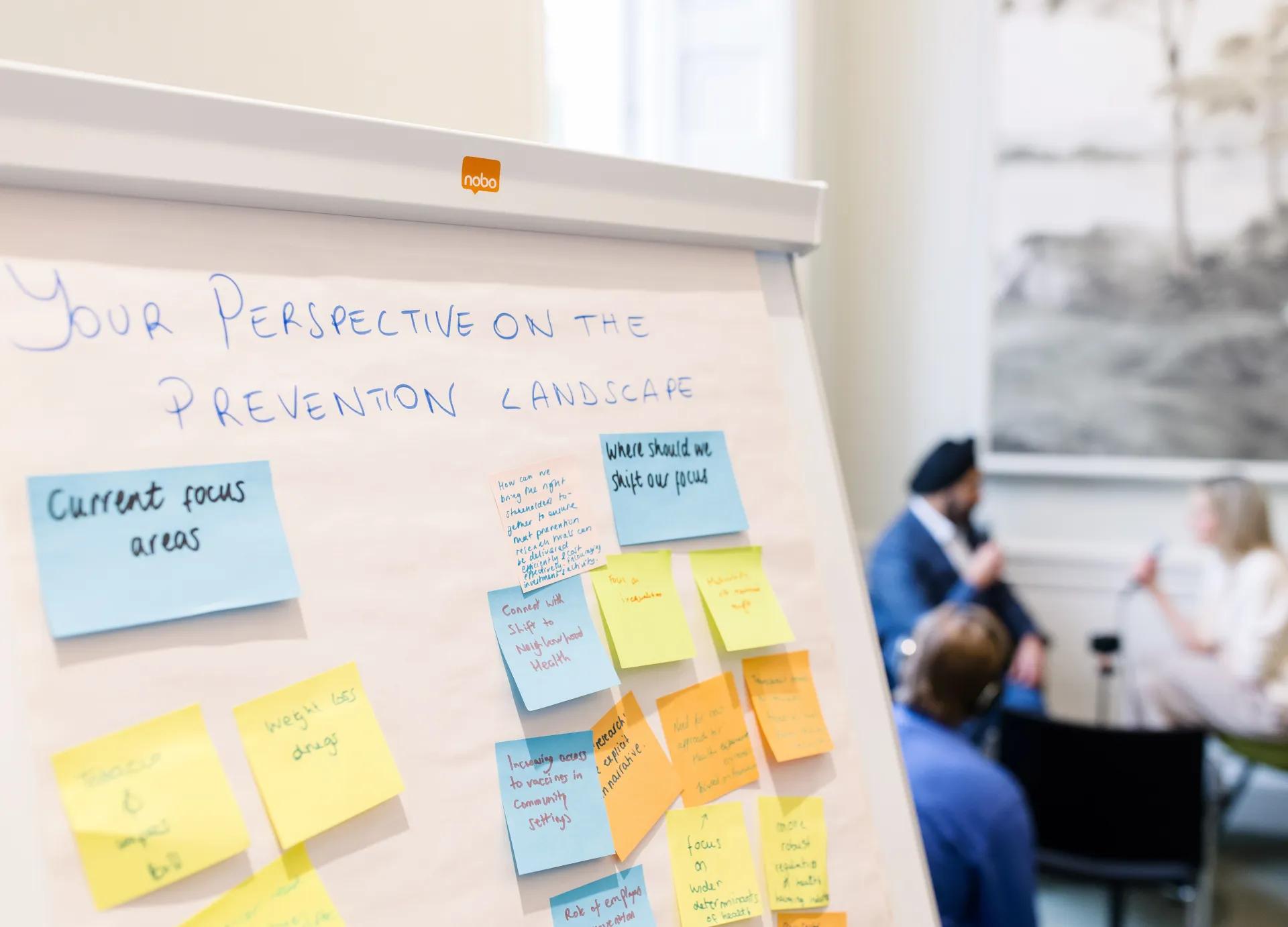
[23:19] James Bethell: On Monday of this week, the Academy of Medical Sciences held what they describe as a catalyst event to mark the start of a new policy program focused on maximising the impact of medical science in prevention and early detection. Steve, I'd say.
Steve Brine: Great people. Thumbs up.
James Bethell: You bet. It's led by CEO Roz Campion, who may be known to many who listen to the show, as the former Head of the Office of Life Science, a really big leader in the life sciences space. And the reason for it was to set out the program's priorities, share some early insights, and outline how partners across research, policy, practice and lived experience can get involved. So I'd really encourage anyone who likes the sound of this to get involved, call Roz, her number's on the AMS website, and if you don't get a hold of her send her an email. People speaking, just to give you a sense of how seriously it was taken, included Professor Sir Chris Witty, Chief Medical Officer and general good bloke, and Sir Harpaul Kumar, Chief Science Officer and President International of GRAIL, another big leader in the prevention space.
Steve Brine: Yeah. That's right. And I know they used the event to unveil their analysis of the UK's prevention innovation landscape, which obviously is something we're interested in. And what's more, James, as you said at the top show, Prevention is the Cure were there. So huge thanks to the Academy for inviting us to be part of this. We're actually gonna hear now from a couple of the speakers who chatted with Charlotte Refsum, Head of Health at Tony Blair Institute and occasional co-host on this podcast with us, who was there for us. She's chatted first to Sir Harpur Kumar and secondly to Emma Greenwood from the Academy. Let's have a listen.
[24:53] Charlotte Refsum: So we are at the Academy of Medical Sciences. We've just heard some really interesting talks. We've heard from Professor Sir Chris Whitty, we've heard from yourself, you are Sir Harpal Kumar, and I was wondering if we could talk a little bit more about some of the things that you touched on in your talk today. I was really interested, first of all, because you had this phrase. You said science is important, but it's not sufficient. What do you mean by that?
Sir Harpal Kumar: Yeah. So what I mean is that we are we're actually very blessed in this country in doing fantastic biomedical science, you know, whether we're looking at new treatments or whether we're looking at, as we have done over many years, some of the preventable causes of disease. What I meant by that comment was that we often develop those scientific insights, but it then takes a long time to move those into practice, whether that practice is clinical practice, something we might do through the NHS, or whether that practice is a more societal one. For example, the sort of progress we make on tobacco. And sometimes it takes us quite a long time to move to implement those insights that we generate from our science. And so what I meant by the comment was we have to think about this both in the context of the additional science we need to do, but also then how do we make that track that science translate into real impact for the public and the population.
[26:23] Charlotte Refsum: Yeah. That's so interesting because you also said that you're extremely optimistic. So why do you why do you say that you're optimistic?
Sir Harpal Kumar: Well, I'm optimistic by nature. I'll start with that. But I'm optimistic because I've seen what can be done. I've seen the fantastic progress we've made in infectious diseases, not least most recently through what we were able to do very rapidly during the pandemic. We've made actually pretty substantial progress in cardiovascular disease, but but we're still lagging behind many other countries. And so we still have a huge challenge in front of us. I'm optimistic because quite frankly, we have no choice. Right? And why do I say that? If we carry on the way we're going, our health system is gonna be unsustainable. And so we're actually gonna be forced into doing some of the things that perhaps we haven't been as urgent about in the past. And I think we really have to address this head on.
[27:22] Charlotte Refsum: Yeah interesting. You touched on a lot of different points in your talk, but you talked specifically about embracing the role of industry and increasing incentives. And I wondered if you could talk a little bit more about that in the role of prevention.
Sir Harpal Kumar: So when I think about how it you know, industry in its broadest sense has revolutionized our lives, you know, whether we think about communications technology, whether we think about, you know, artificial intelligence, whether we think about electric cars, industry can often bring some of the most innovative solutions to bear that helps us evolve, helps us change our lives in ways that we don't always anticipate. But nevertheless, you know, at least on balance, we move forward as a society. In public health, that hasn't really happened to the same extent. It absolutely has helped in drug treatment. So we have fantastic new innovations in drugs that enable us to treat diseases more effectively. But generally speaking, with the exception of the more recent obesity drugs, industry does not tend to get very involved in public health initiatives. And you have to question why. And an industry, you know, again, in its broadest sense tends to get involved where it can see an opportunity, where it can see a way of bringing those ideas to life that can be a commercial success, not just a health success if you like. And, you know, and I it's always struck me that we don't embrace that in in the public health arena. And and that means we are not engaging a very large section of society and to be frank, a very big source of funds to actually address some of the problems that we're trying to address. And that's what I mean by trying to figure out what those incentives might be to get industry much more involved.
[29:27] Charlotte Refsum: I know you're talking specifically about like pharma companies in that instance or are you talking about industry that might be involved in delivery of health services like providers or some other type of industry? The reason I think about it is because if you think about the GLP-1s, for example, there's about 2.5 million people taking these GLP-1s at the moment. Most of them are getting them off the internet. Now I've said this before on this podcast, actually, that a lot of the time we know that the clinical governance isn't amazing. And maybe you want something that's halfway house between, like, a GP and getting everything online. But there's a lot of innovation happening in the private space in terms of models of care. Models of care that are sort of light touch, low cost, mostly digital. And and, again, that's happening through industry. It's happening outside of the NHS. And I just wondered when you're talking about industry and incentives, whether you're just talking about the the discovery of the drug or the test or the screening, or from the delivery side as well.
Sir Harpal Kumar: All of the above.
Charlotte Refsum: Really?
Sir Harpal Kumar: Definitely. I mean, it's you know, this is a this is a massive societal set of issues, and we need to bring all of the innovation to bear, you know, from the development of new technologies, whether that be new screening tests or new diagnostics, all the way through to how do we think about data. You know, data is a powerful asset out there. And I do very carefully use that word asset because it is something that we have available to us that we are just not using right now. There's an awful lot of information in our data that we are not making great use of. And it could tell us an awful lot about disease, about how we prevent disease, how we've detected earlier. We're not making best use of that. You know, with the fantastic data companies we have out there, and of course, you know, they can be controversial, understand that, but but we have to make use of those insights, those innovations that the industry can bring to bear. And, yes, absolutely, then think about how we need to manage those interventions. But we've got to get the ideas, we've got to get the innovations, we've got to get the insights in to addressing what is a very complex series of problems.
[31:46] Charlotte Refsum: Yeah. You talked a bit about data. You talked a bit about the unique kind of place that The UK is in and having this sort of being a crucible of having, you know, science and genomics and longitudinal patient data and all of those sorts of things. And obviously, we've had some developments recently with with the HDRS and and things like that. What are your hopes for how we can, just start to capitalize on some of those unique assets that the UK has?
Sir Harpal Kumar: Well, I think data is one of the areas that gives me a cause for for optimism. But again, I'm afraid we've we've known about this for a long time. We haven't made the progress we should have made. I really hope the the the advent of the HDRS is gonna help us make a step change in this in this arena. But the fact is we have we have data in this country that I wouldn't say is completely unparalleled, but it's certainly very rare across the world. And if we could just make use of that information that we have to really understand where those possibilities are, I think we can make really some very, very big step changes.
Charlotte Refsum: Brilliant. Well, thank you so much for talking us to this today.
Sir Harpal Kumar: Alright. Thank you.
[33:01] Charlotte Refsum: So Emma, we are here at the Academy of Medical Sciences. You're new in your role. Tell us what that is.
Emma Greenwood: Yes. So I am newly joined as Director of Policy here at the Academy of Medical Sciences. So yes, six weeks in and launching our programme of work in prevention and early detection was top of my things to do list on joining and one of the things I'm most excited about, you can sort of see in the room today the buzz around it. It's really hopefully going to be a really impactful year.
Charlotte Refsum: Amazing. You spoke obviously quite a bit about it when you stood up, but can you just tell us a bit more about it here and now?
Emma Greenwood: Yeah. So what we're really trying to do with this policy focus is have a program of work that is tackling the big, difficult questions. I want to hear a range of views and for those to be quite diverse, quite extreme. I want the difficult conversations that we as the Academy of Medical Sciences can help moderate, convene and come out the other end with real clarity as to what we need to be doing, both as a nation but also internationally. Health systems everywhere I think are struggling with how to convert the kind of rhetoric and commitment around prevention and early detection into something that actually works in reality in health systems. So what we don't want to do is kind of go away and think about it and then come back and share a final report with everybody. We want to be publishing as we go, be really on the front foot if there's an opportunity to inform government thinking, to make sure that we are really, really mindful of going after the things that can have the most impact at any given time. So when we get to the end of this programme, we essentially have a whole suite of new original thinking or indeed that we amplify thinking that's already been done but really ask the difficult question as to, well if we have all this brilliant thinking, why hasn't it really translated at pace and scale in the way that we would like?
[35:12] Charlotte Refsum: That's really interesting. And when we were speaking earlier, we were talking a little bit about the value of prevention and how we've sort of underpriced a lot of preventative interventions. Like, maybe you could talk a bit more about that.
Emma Greenwood: Yeah, so I think it's on almost like on so many different levels within the health system. So there's obviously kind of the really obvious value proposition in terms of how do you determine whether an intervention or indeed a pathway of care in the prevention space should be available within the health service and how does that stack up in terms of how we think about other health interventions. I think there's also then the once we have something that's proven and we've said, yes, this should be the thing we do, how do we truly value what it can do within a system such that our funding incentives, commissioning structures, leadership within the system at all levels is really ambitiously pushing for that intervention or new pathway to be routinely available to everybody that should benefit from it. And I think there is such an opportunity to think across all of those different layers quite radically and differently in the way that I think we have the, certainly have the statement of intent to do, but we just haven't quite found a way to operationalize that and to embrace doing some things differently.
[36:35] Charlotte Refsum: Do you know what I was really struck by when we were listening to Chris Witty, or Professor Sir Chris Witty was speaking at the beginning and he really talked a lot about poverty and actually, you know, some really shocking statistics about health span and lifespan for groups in the lowest 10% of of earners, for example. Do you think that poverty will become a part of the theme of what you're doing as part of this work, or is it something you've been thinking about?
Emma Greenwood: So say that inequalities, the social determinants of health, the poverty landscape, especially in this country, it's just we can't ignore it. We absolutely do not want to focus so relentlessly on kind of the new shiny innovations to the point where we're kind of further, like, creating more of a two tier system. You know, as Chris Witty himself said, there's so much that we already know how to do. And we just need to be doing it better, probably tailoring it better to certain parts of the country or certain communities within the country. And I don't think we will be shying away from calling that out. And we so A) we want to have a focus on improving where we see those inequalities, and B) we are really conscious of not pushing forward an agenda that would in any way heighten those important things. We're just not going to make the progress that we want to see on the outcomes that matter to patients if we don't get that right.
[38:09] Charlotte Refsum: And you referenced your earlier career in cancer. I wondered what's the biggest learning you could take from that work and bring into this job?
Emma Greenwood: Oh, I mean I think the brilliant thing with cancer or the challenge with cancer is it's a whole system problem. So the cancer pathway really exposes everything that we could do better in the health system. And I would really love one of the things that we're able to do with this program of work at the Academy to be real clarity on what the entirety end to end of our sort of primary, secondary prevention and early detection health system could look like. Because I actually think cancer shows what is possible in that space from, you know, the very classic tobacco tactics in terms of pulling all of the different levers that are at our disposal to, you know, discourage people from smoking in the first place through to targeted screening programmes, through to if you've had a cancer experience what is your secondary prevention journey to ensure that you've got the best possible chance of not developing the disease again. I think I was very lucky to have that experience working across the entirety of what is possible in cancer. I think there is a real chance now to sort of take the learnings from that and apply that kind of whole pathway, whole system approach to the level of ambition that we have in this space.